

Fire risk management in galvanic and PVD plants: regulatory obligations and best practices
The fire risk in galvanic and PVD plants stems from a combination of factors: high-power electrical systems, pressurized technical gases, and much more. All typical elements of surface treatment facilities.
Galvanic baths mostly work with non-flammable aqueous solutions. PVD plants operate under vacuum. But this is not enough to eliminate the risk. A structured approach, governed by specific laws and regulations, is needed.
Managing fire risk does not just mean installing firefighting equipment like fire extinguishers. The issue involves the entire life cycle of the plant: facility design, choice of technologies, operating procedures, and personnel training.

The regulatory framework
In Italy, there is no specific fire prevention legislation dedicated to galvanic or PVD plants. Safety is regulated by the integration of multiple sources: occupational health and safety, fire prevention, chemical management, and explosive atmospheres.
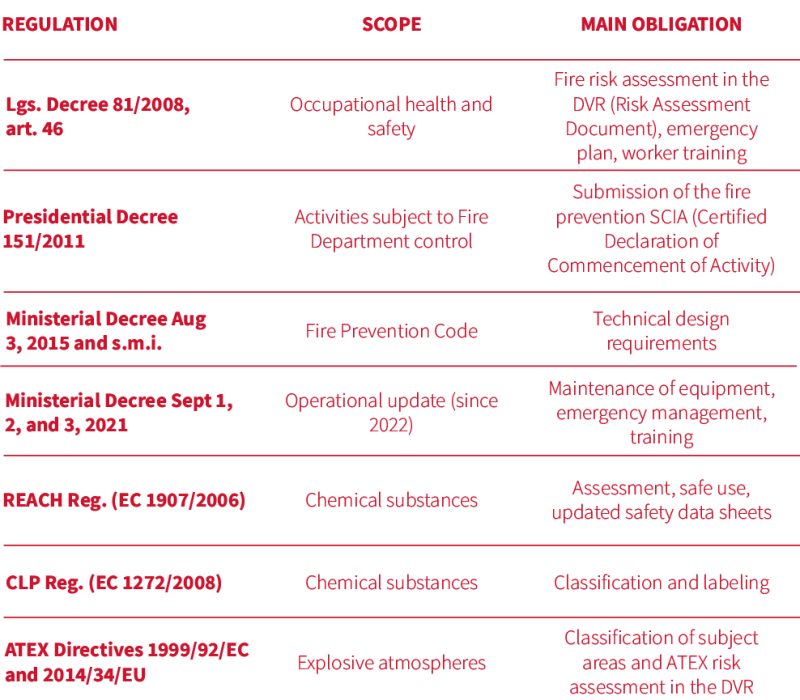
The main reference is Legislative Decree 81/2008. Article 46 requires the employer to prevent fires. In practice: risk assessment in the DVR, prevention and protection measures, emergency plan.
If the activity falls among those subject to the control of Presidential Decree 151/2011, a fire prevention SCIA is also required, submitted to the Fire Department in compliance with the Fire Prevention Code. Since 2022, the framework has been updated by the three Ministerial Decrees of September 2021. Today they are the operational reference also for surface treatments.
The peculiarities of galvanic plants
The galvanic process has specific risk factors. In addition to electrolytic baths, products for degreasing, chemical additives, resins, and plastic materials are used in the plants. All elements that contribute to the fire load.
Then there is the electrical factor. Rectifiers, distribution panels, high currents: automatic electrodeposition requires careful design and constant maintenance. The goal is to reduce faults, overheating, and short circuits.
Another critical point is the fume extraction and abatement systems. They must always be kept efficient. The accumulation of residues can compromise the safety of the entire plant.
The specific aspects of PVD plants
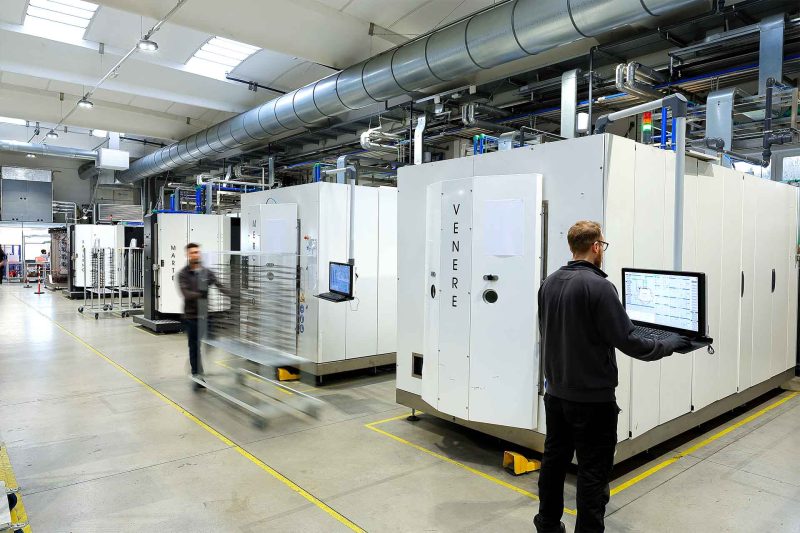
PVD plants have different critical issues compared to traditional electroplating. Vacuum chambers use high-power power supplies, cooling systems, and vacuum pumps, along with technical gases such as argon and nitrogen.
Some processes also involve hydrogen or other gases. In these cases, a dedicated fire and explosion risk assessment is required.
Three elements make the difference:
- correct sizing of electrical systems,
- constant equipment maintenance,
- continuous monitoring of operating conditions,
- correct storage of pressurized technical gases.
Thus, anomalies are intercepted before they become a danger.
Chemical substances: REACH, CLP, SDS and ATEX
Chemical substance management is central to fire prevention. The REACH Regulation (EC 1907/2006) governs registration, evaluation, and safe use. The CLP Regulation (EC 1272/2008) establishes the criteria for classification and labeling.
Safety Data Sheets (SDS) are the key tool. They indicate flammability, incompatibility between substances, correct storage, and suitable extinguishing agents.
Where flammable solvents or substances that can generate explosive atmospheres are present, ATEX legislation (Directives 1999/92/EC and 2014/34/EU) also applies. It governs the classification of areas at risk and the requirements for installed equipment.
Operational best practices
Complying with regulations is the starting point. Truly effective fire risk management is built every day, with simple but constant practices:
- scheduled maintenance of electrical systems and fire-fighting systems;
- periodic inspection of extraction systems;
- separation and identification of incompatible substances;
- order and cleanliness of production areas;
- continuous updating of technical documentation;
- periodic verification of fire-fighting equipment (extinguishers, alarms, escape routes).
Then there is personnel training. Operators must know the risks of the processes, know how to use fire-fighting devices, and know emergency procedures. Periodic drills verify whether the emergency plan really works.
Prevention as an investment
In surface treatments, fire risk management is not simply a compliance issue. It means reducing operational interruptions. Limiting economic damage. Preserving the company’s technological assets.
An integrated vision is needed: design, maintenance, chemical management, training. All elements working together, just as strict quality control accompanies every phase of the production process.
This is also one of the criteria to evaluate when choosing a reliable PVD and galvanic treatment supplier. For technical insights, contact LEM technicians.

Did you find the article interesting? Share it now.
Did you find something interesting? Contact us now!
LEM technicians are ready to address any questions or concerns you may have.
Request more information and discover our tailor-made solutions.