

Thermal evaporation: principle, limits, and comparisons
What is thermal evaporation?
Thermal evaporation is one of the fundamental techniques of PVD (Physical Vapour Deposition): the source material is heated to its evaporation temperature, releasing atoms that propagate in the vacuum chamber and deposit on the substrate, forming a thin film.
It is one of the most established forms of physical vapor deposition, still used in specific industrial and electronic applications.
How heating occurs
Energy transfer to the source material occurs through two main approaches:
- Joule effect (thermal resistance): the material is placed in a conductive crucible crossed by an electric current. The heat generated brings the material to the evaporation temperature. It is the simplest method, suitable for materials with a relatively low melting point such as aluminum, silver, copper, and gold.
- Electron beam (e-beam): a high-energy electron beam is directed precisely onto the source material, heating it locally until evaporation. It allows working with high-melting-point refractory materials, platinum, tungsten, ceramic oxides, that cannot be processed by a simple Joule effect.
The role of vacuum and mean free path
The process works exclusively under high vacuum conditions. At these pressures, the density of residual gases is low enough to ensure that the evaporated atoms travel in a straight line from the source to the substrate, without collisions that would disperse their energy and direction. The quality of the vacuum is therefore directly related to the uniformity and adhesion of the deposited film.
Material compatibility and crucible selection
Not all materials evaporate with the same efficiency. The determining parameter is vapor pressure: a material with high vapor pressure at the process temperature evaporates quickly and controllably; one with very low vapor pressure is difficult to process with this technique.
The choice of the crucible, tungsten, alumina, graphite, is equally critical: it must be chemically inert with respect to the material to be evaporated to avoid cross-contamination that would compromise the properties of the final film.
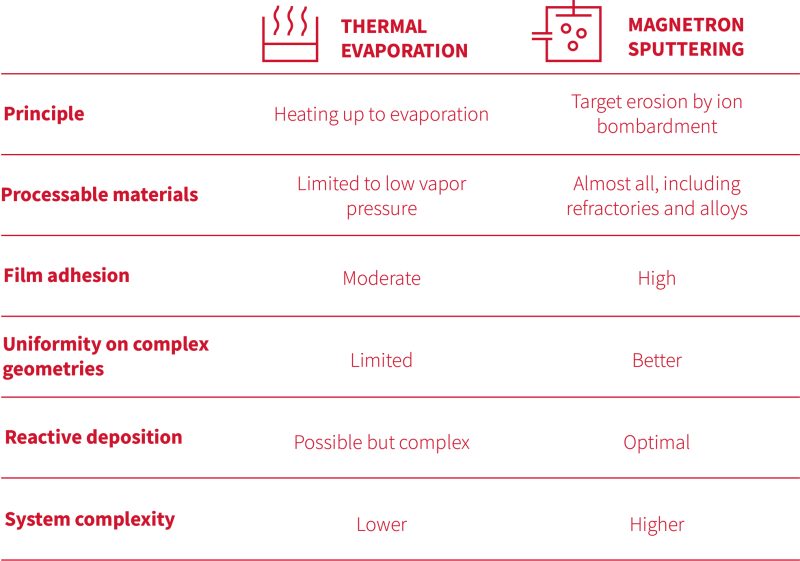
For high-precision decorative and functional applications, such as those made in LEM’s PVD systems, magnetron sputtering is generally preferred for the superior quality and uniformity of the film. Thermal evaporation remains the most efficient choice in specific contexts where the simplicity of the process and the nature of the material make it more suitable.
Related topics: PVD Target

Did you find the article interesting? Share it now.
Did you find something interesting? Contact us now!
LEM technicians are ready to address any questions or concerns you may have.
Request more information and discover our tailor-made solutions.