

PVD Decoating: what it is, when it is applied, and how to preserve the base material
Decoating is a chemical or mechanical treatment aimed at removing a previously applied PVD coating while preserving the integrity of the underlying base material. Not to be confused with pre-deposition surface cleaning: decoating intervenes on already coated pieces, with the goal of returning them to the bare substrate state for subsequent re-treatment or disposal.

When it is necessary
Decoating becomes necessary in three main scenarios:
- Production rejects. A coated piece with a defective finish, off-spec color, insufficient adhesion, or aesthetic defects cannot simply be painted over. The existing coating must be removed before proceeding with a new deposition cycle.
- Recovery of equipment and molds. Tools, molds, and production equipment coated with functional PVD films wear out over time. Decoating allows the depleted film to be removed and the piece to be prepared for a new coating, extending the useful life of the equipment without the need for replacement.
- Management of excess inventory. Stocked components with finishes no longer demanded by the market can be recovered through decoating and re-treated in the current finish, avoiding waste and the related cost of reworking or disposal.
Decoating methods
The choice of method depends on the type of coating, the substrate material, and the dimensional tolerances of the piece:
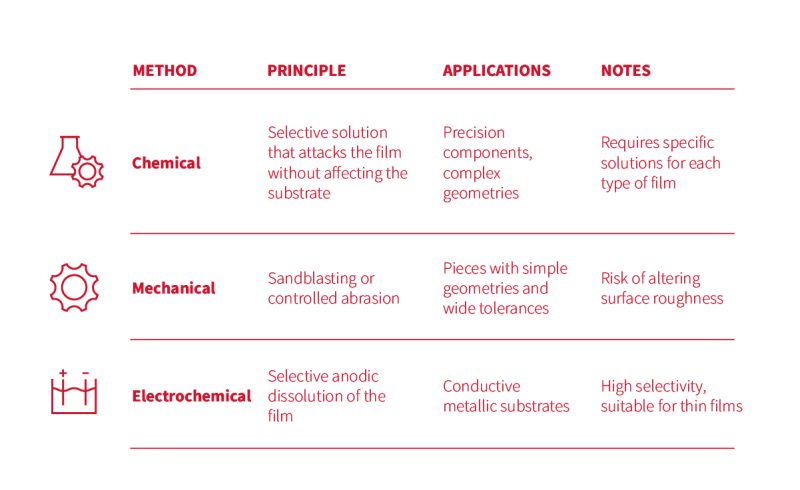
The critical issue: process selectivity
The fundamental requirement of decoating is selectivity: the treatment must remove the coating without altering the roughness, dimensions, or metallurgical state of the substrate. A piece that exits decoating with the substrate damaged, scratched, corroded, or dimensionally out of tolerance is not immediately recoverable for a new deposition cycle, requiring further process steps to be restored to its original condition. In the most critical cases, the piece must be discarded.
This selectivity is not a given: PVD films are hard and chemically stable materials, characteristics that make them perform well in operation but make their removal a technical process in itself, requiring specific knowledge of the film/substrate system.
Contact LEM to evaluate the feasibility of a Decoating process.
Related articles: PVD treatments · PVD systems

Did you find the article interesting? Share it now.
Did you find something interesting? Contact us now!
LEM technicians are ready to address any questions or concerns you may have.
Request more information and discover our tailor-made solutions.