

Zamak: Characteristics, Workability, and Compatibility with Electroplating and PVD Coatings
Zamak: a widespread, often underestimated material
Buckles, buttons, zippers, handles, eyewear, and plumbing components: a large portion of the metal accessories we use daily are made of zamak. Yet, when it comes to applying a surface coating, whether electroplating or PVD, this material requires specific technical attention that is not always considered with due accuracy.
This article analyzes the properties of zamak, the reasons for its widespread use in the fashion and design sectors, and, above all, what happens when this substrate enters a surface finishing cycle: what preparations are necessary, where the critical issues lie, and how to guarantee a long-lasting result.
What is Zamak and why is it chosen?
Zamak (also known as Zama) is a family of zinc-based alloys (approx. 95–96%) containing small percentages of aluminum, magnesium, and copper. Its composition is strictly controlled, and the zinc used is of high purity, two factors that determine the material’s mechanical properties and workability.
The strength of zamak lies in its low melting point (below 400°C), which results in high fluidity of the liquid metal during casting. This allows zamak to be manufactured via die-casting: a production process capable of reproducing complex geometries, thin details, and near-net-shape surfaces with very precise dimensional tolerances.
Compared to materials like brass or steel, zamak die-casting offers a decisive advantage: it allows for shapes that would be difficult or economically prohibitive to achieve with other metals. Profiles with undercuts, embossed textures, or intricate geometries are manageable with zamak at contained production costs, without requiring expensive additional machining.
Key properties of the alloy include:
- Mechanical stability sufficient for accessories and components.
- Fair resistance to wear and native corrosion, further improvable with surface treatments.
- Excellent dimensional repeatability from batch to batch.
This is why zamak is widely adopted in sectors such as leather goods, apparel, furniture, and faucets, contexts where the balance between cost, aesthetics, and mechanical performance is critical.
The structural limit: Die-casting porosity
While die-casting is advantageous, it carries an inherent flaw: during the melting and solidification process, micro-porosity can form internally or on the surface of the alloy. These are micro-cavities that may be invisible to the naked eye but become critical points when the piece undergoes a surface coating treatment.
These porosities reduce the material’s density, trap contaminants that are difficult to remove, and can compromise coating adhesion. This is where the quality of the finished product is determined; therefore, substrate selection and surface preparation are never secondary steps.
Electroplating on Zamak: Preparation and process sequence
Applying an electroplated coating to zamak is not a standard operation. Zinc is a reactive metal: it oxidizes quickly at room temperature, and die-casting porosities complicate surface cleaning. Without proper preparation, the coating will not adhere uniformly, and the part may exhibit defects, blistering, or localized peeling shortly after use.
The correct sequence involves five distinct phases:
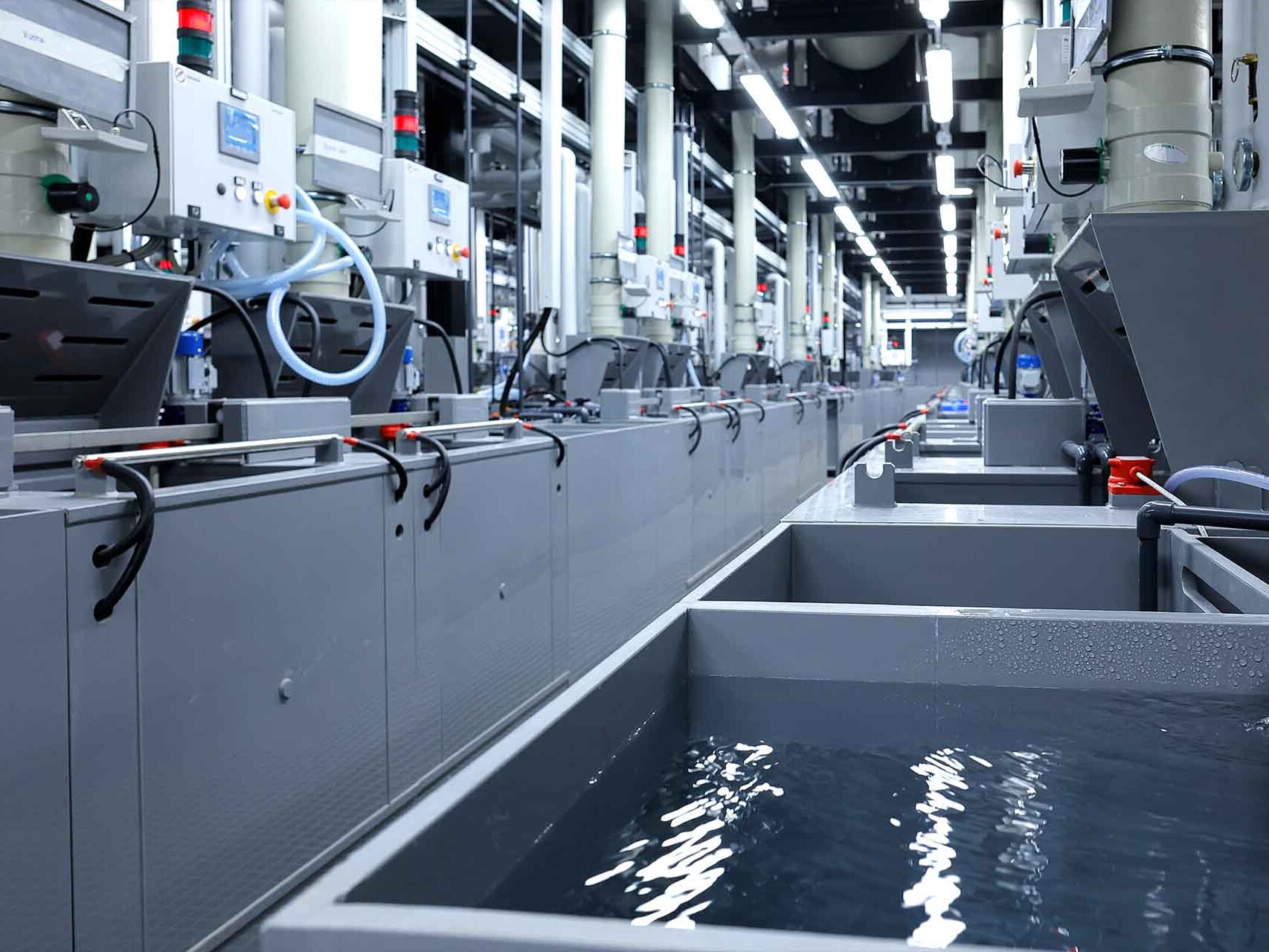
- Degreasing: Removal of oils, fats, and molding residues using chemical, electrolytic, or ultrasonic cleaning. The goal is a surface completely free of organic impurities.
- Pickling and Activation: Treatment with diluted acids (hydrochloric or light sulfuric acid) to eliminate surface oxides and increase the metal’s wettability. This phase “reactivates” the surface for subsequent deposits.
- Primer Layer (Alkaline Copper): A thin film of alkaline copper is deposited directly onto the clean zamak. This intermediate layer acts as a uniform anchor for finishing metals and significantly reduces the risks of poor adhesion linked to zinc reactivity.
- Base Plating (Acid Copper + Nickel or Bronze): The acid copper layer levels the substrate surface, compensating for residual irregularities. This is followed by a nickel barrier layer (or bronze for hypoallergenic finishes) to complete the preparation.
- Finishing (Gold, Palladium, Ruthenium): The final deposit determines the aesthetic result and ensures protection against external chemical agents.
Without this complete sequence, even a single missing or poorly executed step can compromise the entire coating. Residual oxides or untreated micro-porosities create areas of poor adhesion that often manifest progressively during the product’s lifespan.To learn more about the galvanic process and available systems: Galvanic Treatments — Automatic Electroplating Plant.
PVD on Zamak: Opportunities, challenges, and process management
PVD (Physical Vapor Deposition) is a vacuum coating technology that deposits ultra-thin metallic or ceramic films with high hardness and excellent wear resistance. However, PVD does not bond well directly to pure zinc: zinc has a low boiling point and poor anchoring properties for atomic films deposited in a vacuum chamber.
This means that direct PVD on zamak is not feasible. The film would deposit unevenly and tend to detach over time. The solution is a preparatory electroplating treatment that creates a compatible intermediate layer (nickel, copper, bronze, or palladium) upon which the PVD can bond correctly.
The complete chain: Electroplating + PVD
When treating a zamak part with PVD, the cycle does not consist of the vacuum phase alone. It necessarily includes the preparatory electroplating treatment. This has practical implications for lead times, costs, and process complexity.
Once the pre-treatment is complete, the part enters the PVD chamber. Critical parameters include:
- Temperature: Must remain moderate to avoid altering the alloy’s microstructure (due to its low melting point).
- Vacuum: Fundamental for the quality and uniformity of the deposit.
- Deposition time and reactive gas composition: These determine the thickness, color, and hardness of the final film.
Why the Zamak + PVD combination is often problematic
The complexity lies in the variables inherent to the zinc alloy: batch composition, die-casting quality, porosity, and part geometry. Even a single factor out of control can lead to blistering, localized detachment, or non-uniform colors.
For this reason, it is recommended to validate the process for every single item before mass production. Preliminary validation allows for identifying specific issues (geometry, porosity distribution, behavior in the galvanic bath) and adjusting the process accordingly. This approach requires time initially but prevents costly waste and rework once production starts.
For further information: PVD Treatments — PVD System — PVD vs. Electroplating: differences, advantages, and limitations.
Zamak Comparison: When to choose it and when to consider alternatives
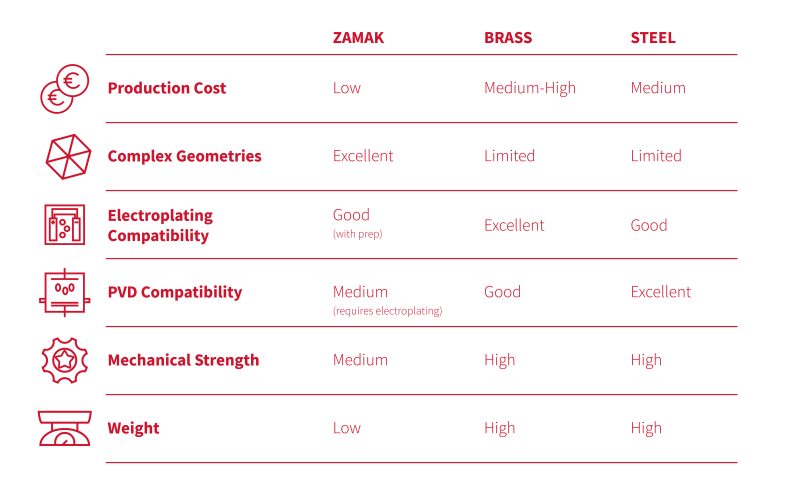
Zamak is not inherently a “difficult” material; it is a material that requires process expertise. Manufacturers must understand zinc reactivity and die-casting porosity to structure the finishing cycle correctly.
Conclusions
Zamak remains the correct choice when a project prioritizes complex shapes, mass production, and cost-efficiency, provided the supply chain guarantees adequate control over substrate quality and the coating process.
At LEM, managing critical substrates like zamak is part of our daily know-how. Every item is evaluated individually, with a validation phase that defines the optimal cycle before series production.
Do you have a zamak component that needs coating? Contact us for a preliminary technical evaluation. Our internal laboratory and industrialization service are available to analyze your specific case and identify the most suitable solution.

Did you find the article interesting? Share it now.
Did you find something interesting? Contact us now!
LEM technicians are ready to address any questions or concerns you may have.
Request more information and discover our tailor-made solutions.