

Reactive deposition: PVD with reactive gas
What’s reactive deposition?
Reactive deposition is a variant of the PVD (Physical Vapour Deposition) process in which a reactive gas, typically nitrogen (N₂), oxygen (O₂), or hydrocarbons, is introduced into the vacuum chamber and chemically reacts with the material vaporized from the target. The result is not a film made solely of the source material, but a compound with specific and controllable properties: nitrides, oxides, carbides.
It is the mechanism that transforms PVD from a simple material transfer technique into a custom coating synthesis technology.
Why is reactive deposition relevant: multiplying the application possibilities
In standard PVD, the deposited film replicates the target’s composition: a titanium target produces a metallic titanium film. By introducing nitrogen into the chamber, the vaporized titanium reacts and forms titanium nitride (TiN), the high-hardness, gold-colored coating among the most widely used in decorative and functional applications.
By varying the reactive gas and the target material, compounds with very different properties are obtained:
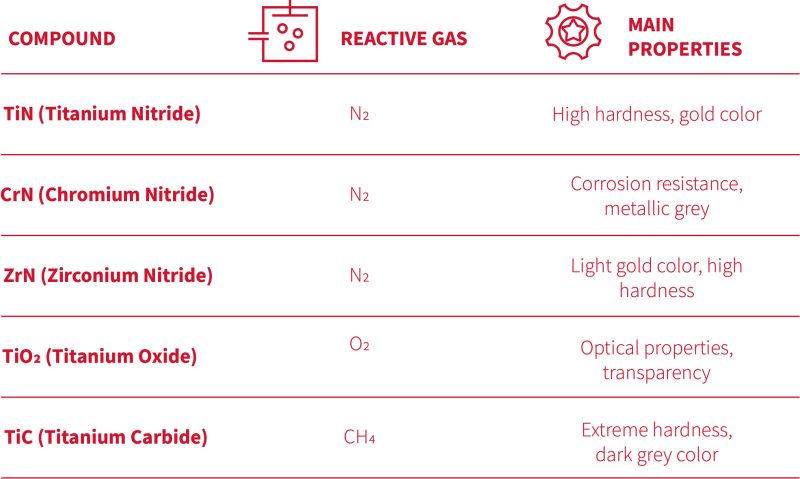
Every colored finish in decorative PVD, gold, black, gunmetal, blue, is the result of a reactive process in which gas, target, and parameters are combined to achieve the compound with the required optical and mechanical properties.
Stoichiometry and target poisoning: the critical parameters
The ratio between the reactive gas flow and the vaporized material flow defines the exact chemical composition of the film, and consequently its color, hardness, and transparency. Small variations produce significantly different results: the precise control of this balance is what ensures the repeatability of the coating from one production cycle to another.
The main risk is target poisoning: when the reactive gas flow exceeds a critical threshold, the target’s surface becomes covered with the compound being synthesized, drastically lowering the deposition rate and compromising the quality of the film. Managing this instability requires control systems that monitor the process parameters in real-time, actively intervening to keep the process in the stability zone.
The quality of a PVD coating depends largely on the equipment’s ability to govern this balance.
Discover LEM’s PVD systems

Did you find the article interesting? Share it now.
Did you find something interesting? Contact us now!
LEM technicians are ready to address any questions or concerns you may have.
Request more information and discover our tailor-made solutions.