
Vibratory finishing: what it is and how it works
What is “vibratory finishing” (or “tumbling”)?
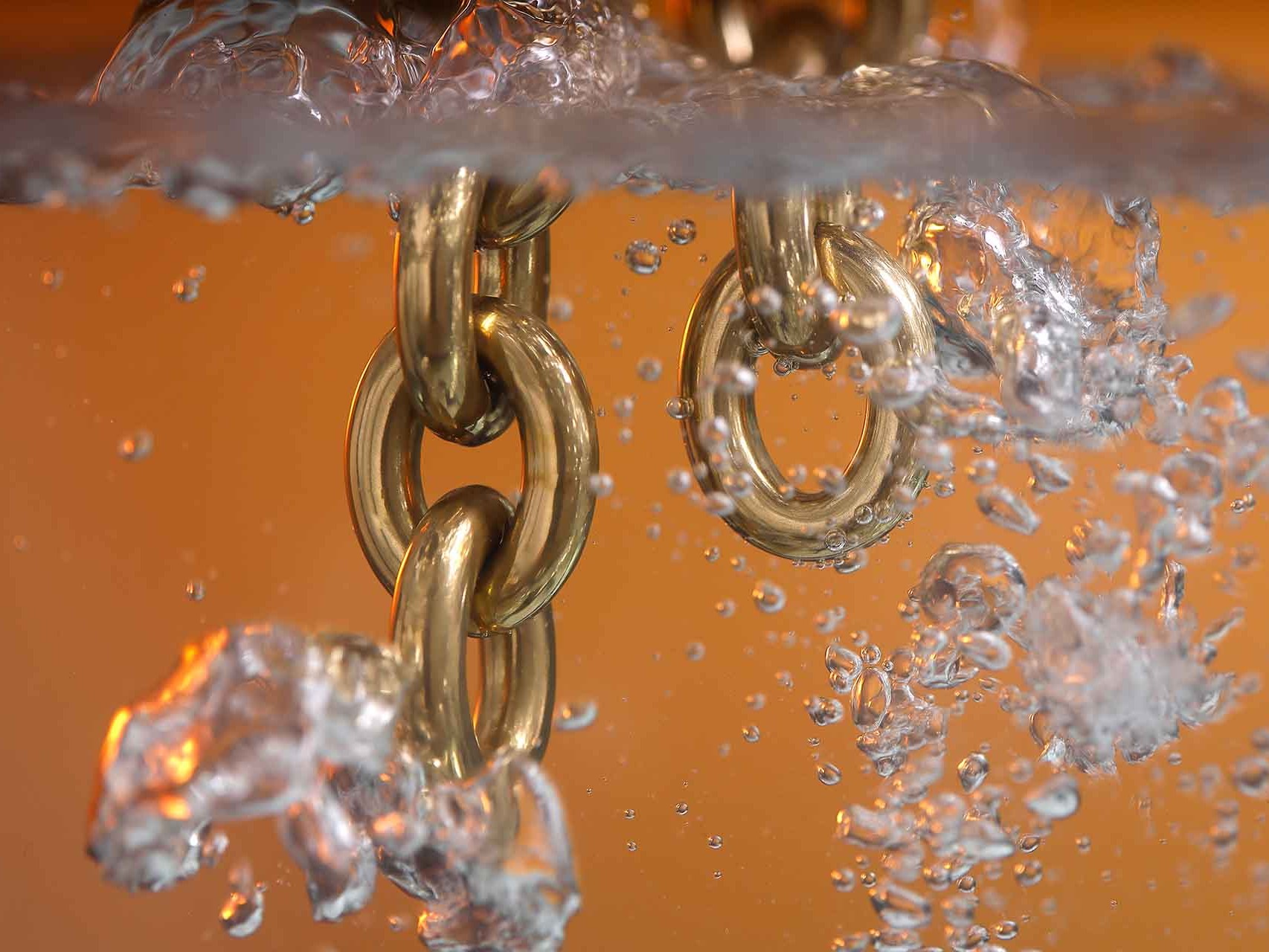
Vibratory finishing (often referred to as barrel tumbling in industrial jargon) is a mass finishing process used for the preparation of metal surfaces.
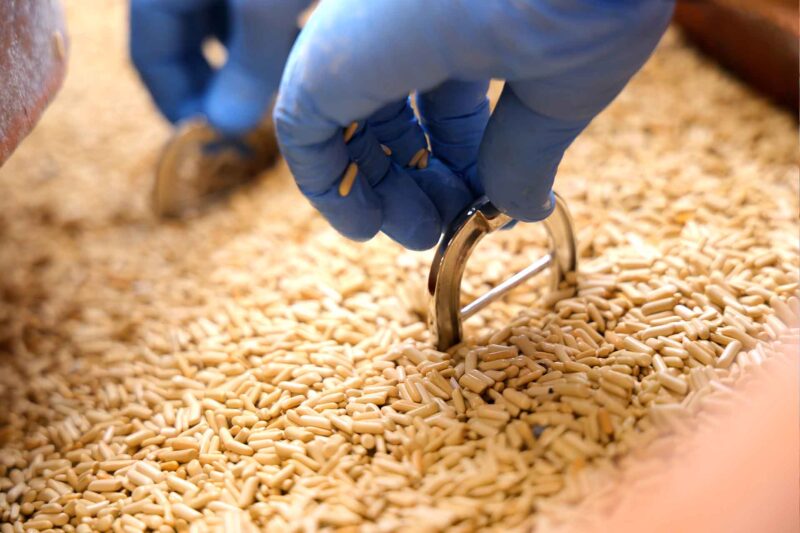
It relies on the mechanical rubbing action between the workpieces and specific abrasive media (inserts), combined with water and chemical compounds inside vibrating tubs.
At LEM, vibratory finishing is not merely an aesthetic operation, but a surface engineering phase that guarantees optimal adhesion for subsequent Galvanic and PVD treatments.
The Three Phases of Vibratory Finishing at LEM
The vibratory finishing process is divided into three main areas, depending on the required technical and aesthetic objectives:
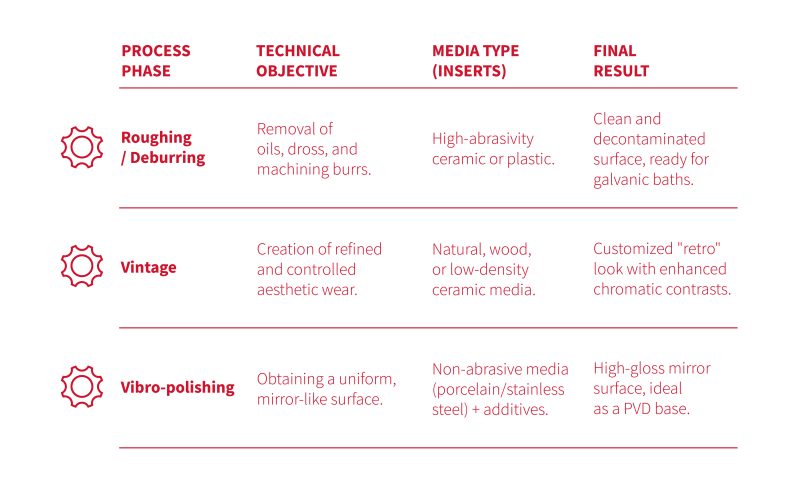
Mechanical Degreasing and Decontamination
Before any surface treatment, it is necessary to remove contaminants resulting from mechanical processing (oily residues, molding burrs, or CNC cutting micro-dross).
- How it works: Controlled friction with ceramic or plastic media “cleans” the workpiece in every cavity, even in the most complex geometries.
- Why it matters: A perfectly mechanically degreased surface drastically reduces the risk of PVD or galvanic coating peeling.
Vibro-polishing (Mirror Finish)
For sectors requiring impeccable aesthetics, such as high fashion and luxury automotive, vibro-polishing represents the gold standard.
- The process: Through high-frequency cycles and the use of brightening additives, a mirror-like, uniform surface free of microscopic scratches is achieved.
- Result: It creates a perfectly smooth (“isotropic”) base that allows the PVD color to stand out with maximum brilliance and color fidelity.
Vintage Finish (Controlled Aging)
The Vintage Finish is an exclusive LEM process that combines mechanical abrasion with selective chemical treatments to give objects a “lived-in,” retro, yet highly refined appearance.
- Customization: By using different types of inserts and processing times, LEM can calibrate the desired degree of wear, ensuring the repeatability of the effect across entire production batches.
- Design: It is the ideal choice for brands looking to enhance the volumes and details of an accessory, creating unique light contrasts.
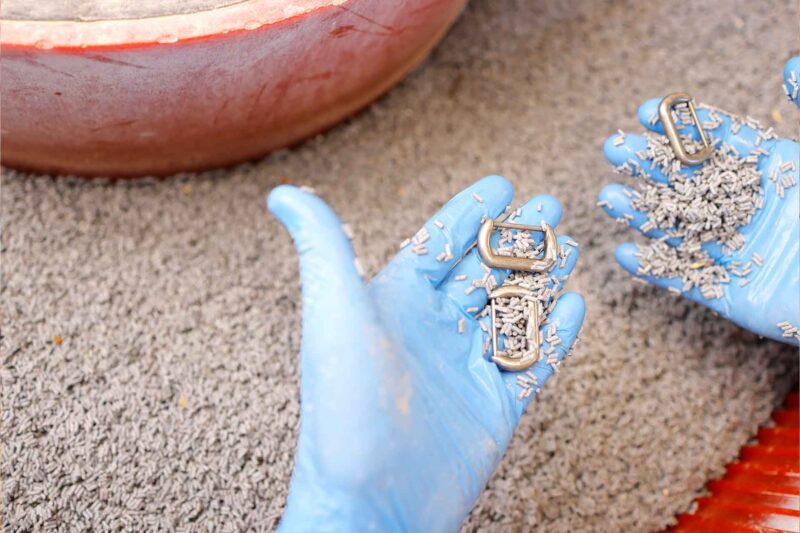
LEM Vibratory Finishing Systems
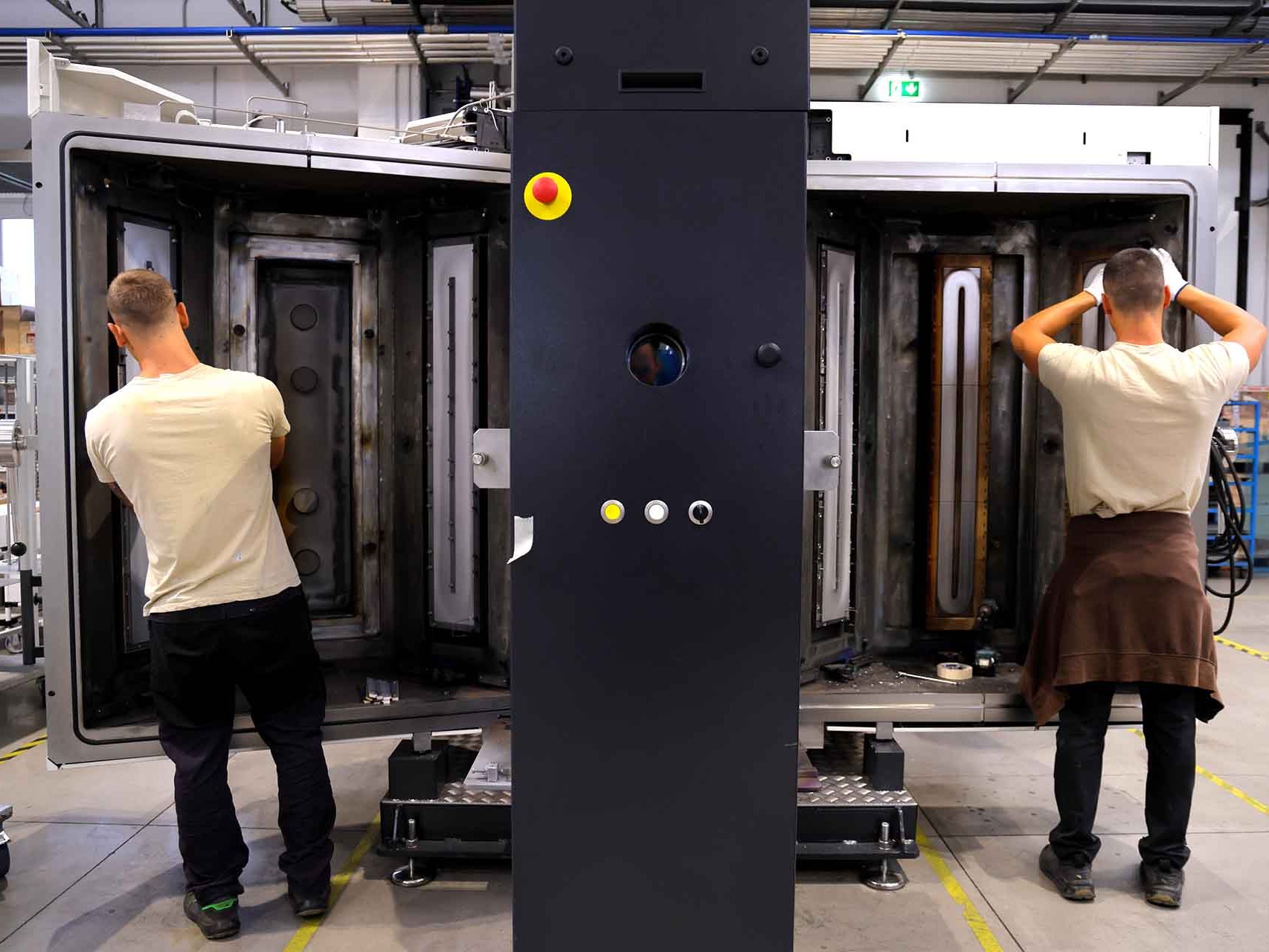
LEM features state-of-the-art vibratory finishing systems to handle various types of production:
- Continuous Cycle Systems: Designed to handle large volumes quickly, ensuring a constant flow and standardized quality.
- Batch Systems: Ideal for delicate pieces or highly customized finishes (such as Vintage or intense Vibro-polishing), where every parameter must be monitored with extreme precision.
Processable materials include the main industrial metal alloys: Brass, Zamak, Steel, and Aluminum.
The Role of Vibratory Finishing in the PVD Supply Chain
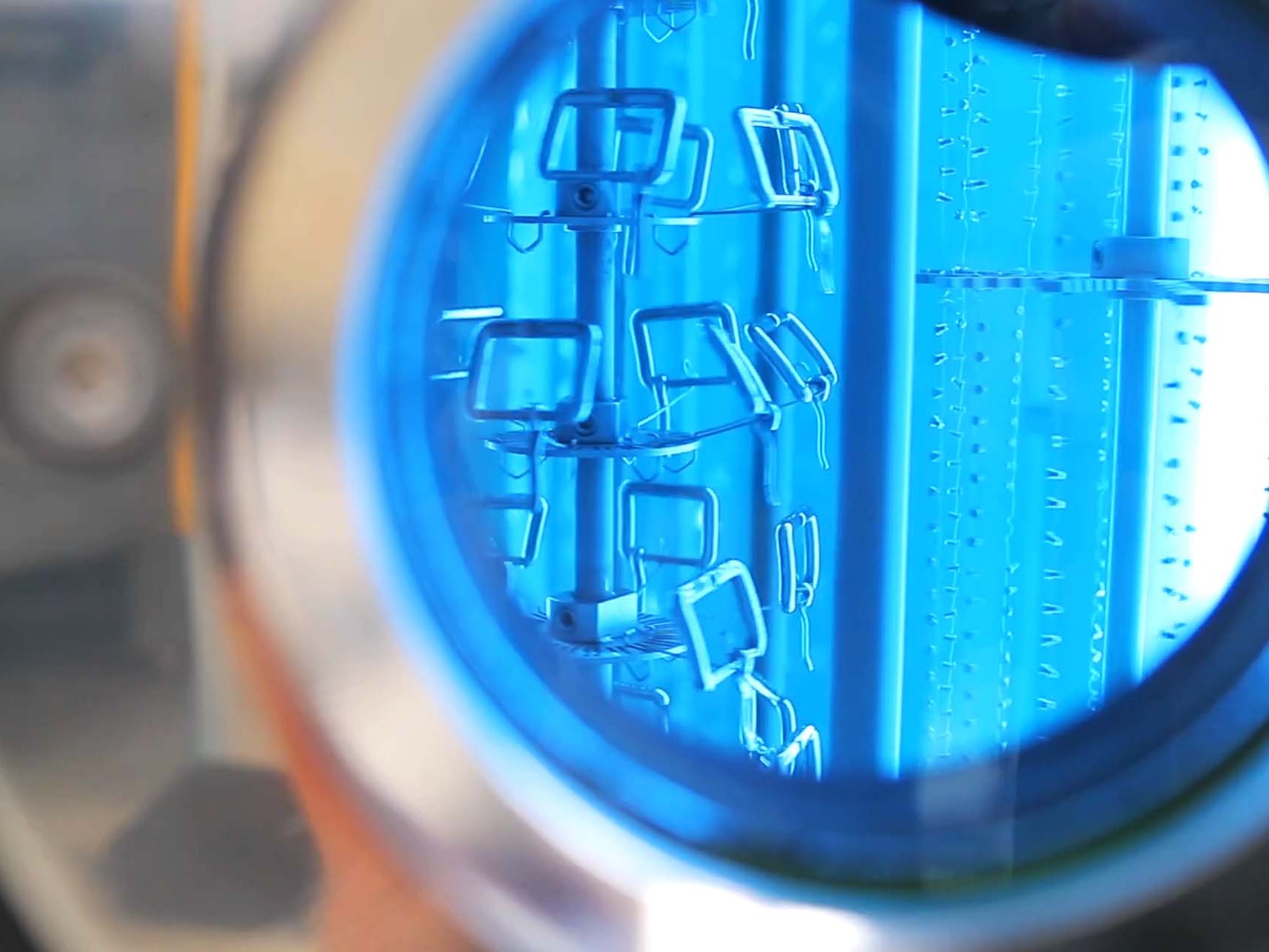
Why is vibratory finishing the best ally of PVD? The PVD coating has a micrometric thickness: this means it faithfully “copies” the underlying surface.
If the surface has micro-scratches, burrs, or impurities, PVD will make them even more visible. A properly executed vibratory finishing cycle at LEM prepares the ideal “substrate,” eliminating every imperfection and ensuring that the atomic PVD film adheres perfectly, guaranteeing superior resistance and an outstanding aesthetic yield.
Water Resource Management
In line with LEM’s corporate philosophy, our vibratory finishing processes are integrated into a closed-loop system. The process water is sent directly to our internal purification plants, where it is filtered and treated to minimize environmental impact and recover water resources.

Did you find the article interesting? Share it now.
Did you find something interesting? Contact us now!
LEM technicians are ready to address any questions or concerns you may have.
Request more information and discover our tailor-made solutions.