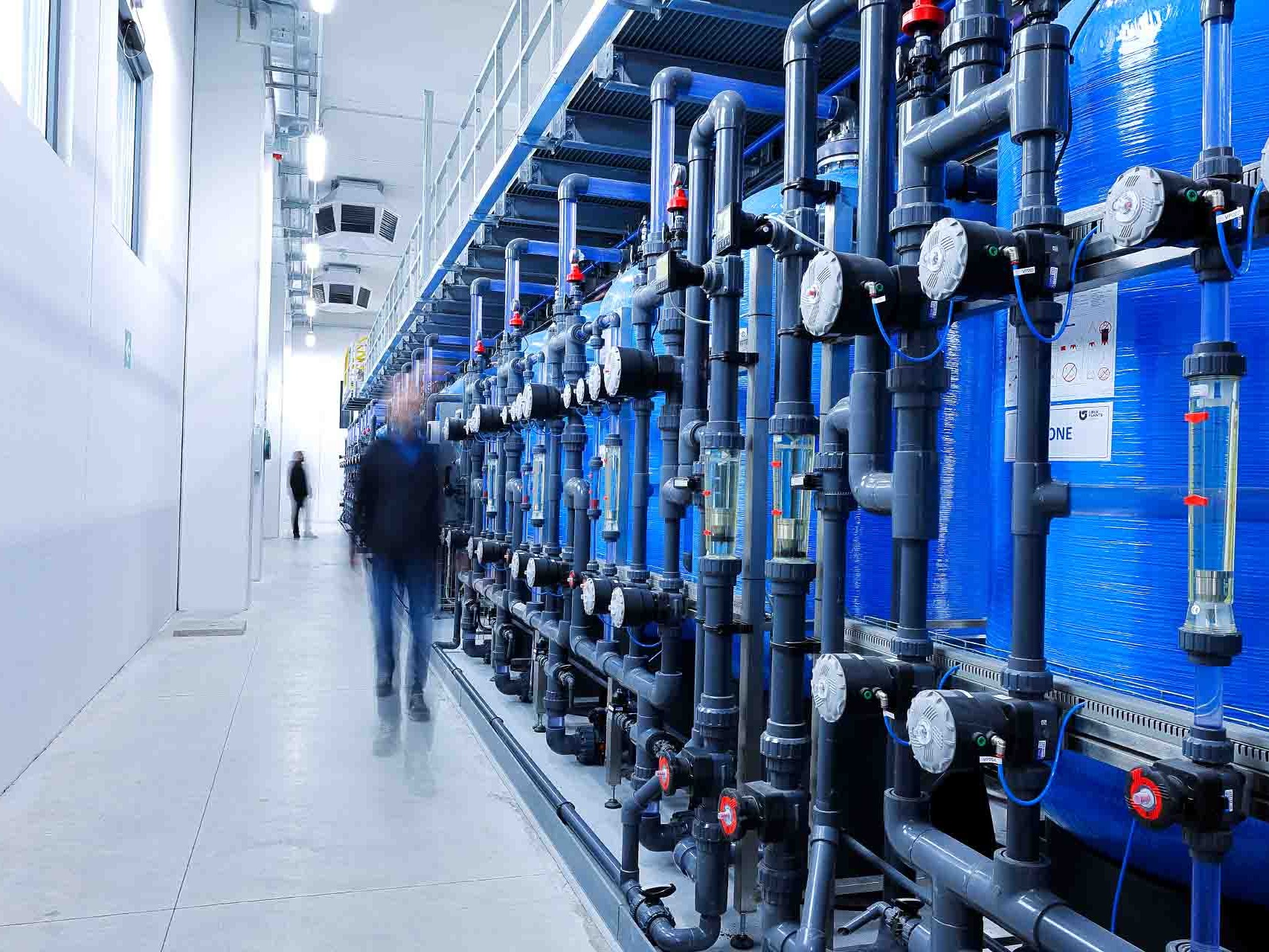

How a PVD System Works: Technologies and Processes Explained
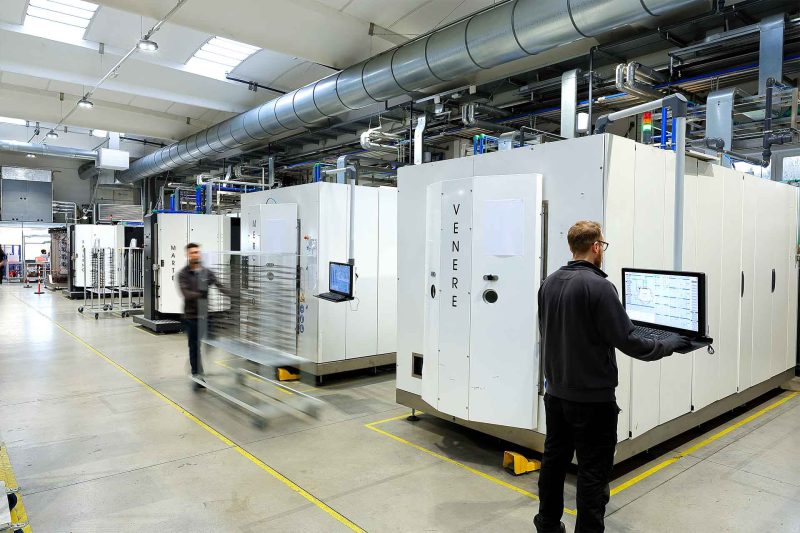
Inside LEM PVD Division
How does a Physical Vapor Deposition (PVD) system actually operate? What are the key steps that transform a metal component into a product with a resistant, uniform, and stable finish over time?
In this article, we go inside the LEM PVD plant to analyze its structure, technologies, and operational phases: from vacuum management to process parameter control, including the main deposition methods such as sputtering, evaporation, and cathodic arc.
This deep dive is designed to offer a clear and comprehensive view of the dynamics that determine the quality, repeatability, and performance of the final coating.
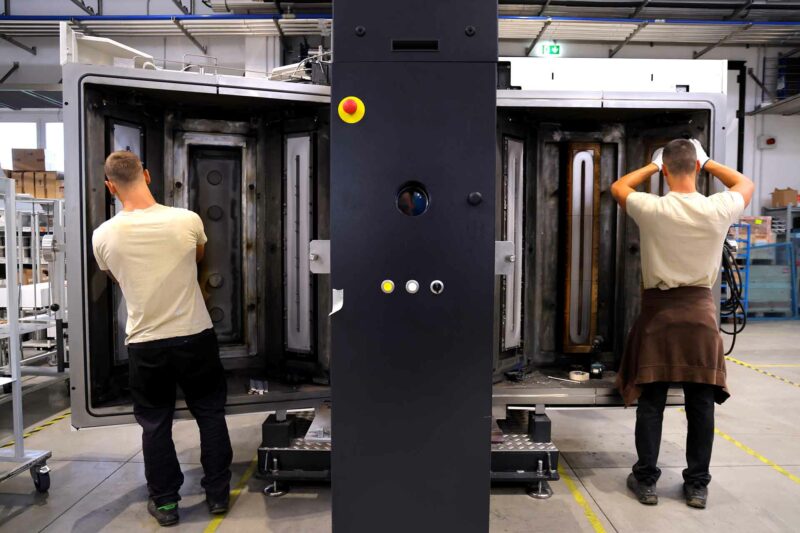
Components and Processes of a PVD System
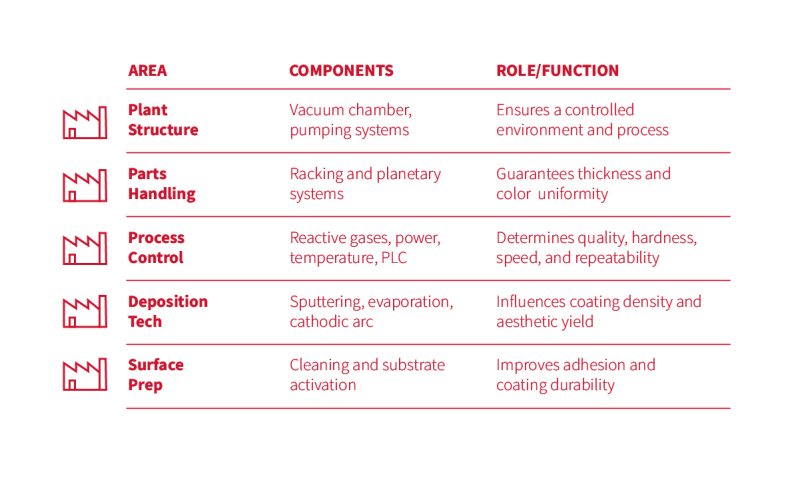
The Structure of a PVD System
A PVD plant is an integrated system composed of several interconnected modules, where every element directly affects the final result.
1. Vacuum Chamber and Management
The vacuum chamber is the heart of the system. Made of heavy-duty stainless steel, it must withstand significant pressure differentials. The entire deposition process takes place inside this chamber.
The pumping system is generally divided into two stages:
- Primary Vacuum: Achieved through mechanical pumps (rotary and Roots).
- High Vacuum: Reached using turbomolecular or diffusion pumps.
During the evacuation phase, a pressure of approximately 10⁻³ Pa is reached to totally remove air and contaminants. Deposition occurs between 10⁻² and 10⁻¹ Pa. Vacuum stability is critical: it affects adhesion, uniformity, and the final color of the coating.
2. Racking and Parts Movement
In Physical Vapor Deposition, the process is “line-of-sight”: the material deposits where it can physically reach. Therefore, component movement is vital.
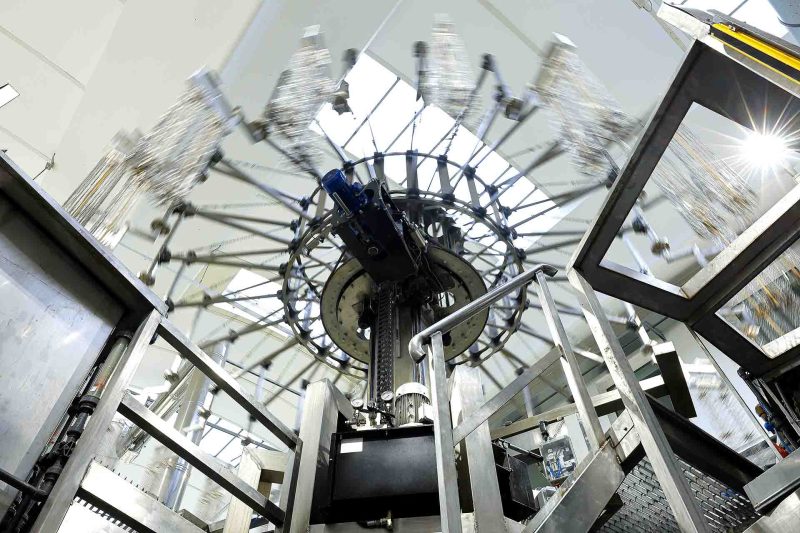
Modern systems use planetary kinematic systems with single, double, or triple rotations, which allow for:
- Reduction of the shadowing effect.
- Uniformity on complex 3D geometries.
- Consistent thickness across the entire surface.
Incorrect movement leads to chromatic differences or non-compliant thicknesses, issues that are particularly critical in the fashion and luxury sectors.
3. Sources and Targets
The sources are installed on the chamber walls—devices that transform solid material (targets) into atoms ready to be deposited onto the substrate.
Targets can be made of pure metals such as titanium, zirconium, chromium, or gold. The choice of material determines:
- Final color
- Surface hardness
- Chemical and mechanical resistance
By introducing reactive gases like nitrogen or acetylene, metal nitrides or carbides are formed, reaching surface hardness values exceeding 2000 HV.
4. Gas Control and Automation
Process control is managed by high-precision Mass Flow Controllers (MFC) and a PLC (Programmable Logic Controller) that handles operational “recipes.”
Pressure, gas flow, power, temperature, and deposition times are automatically coordinated. This level of automation ensures:
- Color repeatability
- Thickness consistency
- Quality standards suitable for mass production
The PVD Process: Operational Phases
Beyond the hardware, it is essential to understand the operational steps that precede and accompany the deposition.
1. Substrate Preparation
The quality of the film largely depends on surface preparation.
- Cleaning: Chemical degreasing to eliminate oils and industrial residues, solvent or ultrasonic cleaning, and rinsing with deionized water.
- Surface Activation: Plasma cleaning to remove oxides and increase surface reactivity.
The goal is to guarantee long-term adhesion and coating durability.
2. Loading and Geometric Management
Components are placed on rotating, conductive supports (for metal substrates) to facilitate atomic bonding. Correct positioning reduces “blind spots” and contributes to a uniform finish.
3. Vacuum Creation and Stabilization
Once the chamber is sealed, the vacuum is drawn down to values in the range of 10⁻³ Pa.
The vacuum allows for:
- Controlled atom transport.
- Reduction of oxygen and humidity.
- Higher film density.
Main PVD Technologies
Different deposition technologies can be integrated within a single plant.
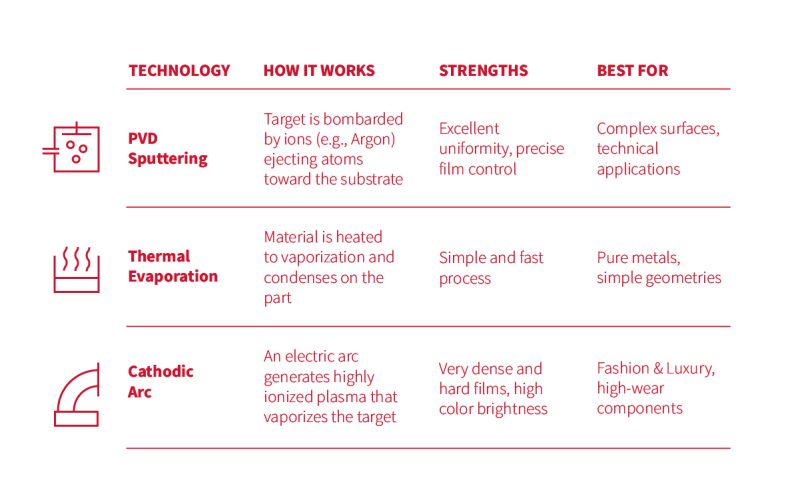
Summary Table – Main PVD Technologies
PVD sputtering
The target is bombarded by ions (typically Argon). The ejected atoms deposit on the substrate.
- Pros: Excellent uniformity, compatible with alloys and ceramic materials, extremely smooth finish.
- Cons: Relatively lower deposition rate and more complex process management.
Thermal Evaporation
Material is heated until it vaporizes and then condenses on the part.
- Pros: Fast and simple process.
- Cons: High directionality (less suitable for complex shapes), less compact coatings with limited mechanical properties.
Cathodic Arc
An electric arc vaporizes the target, generating a highly ionized plasma.
- Pros: Very dense films, high hardness, excellent chromatic yield.
- Cons: Potential presence of micro-particles requiring dedicated management.
Process Parameters: Where Quality is Determined
Pressure, gas composition, source power, substrate temperature, deposition time, and part rotation are the key variables.
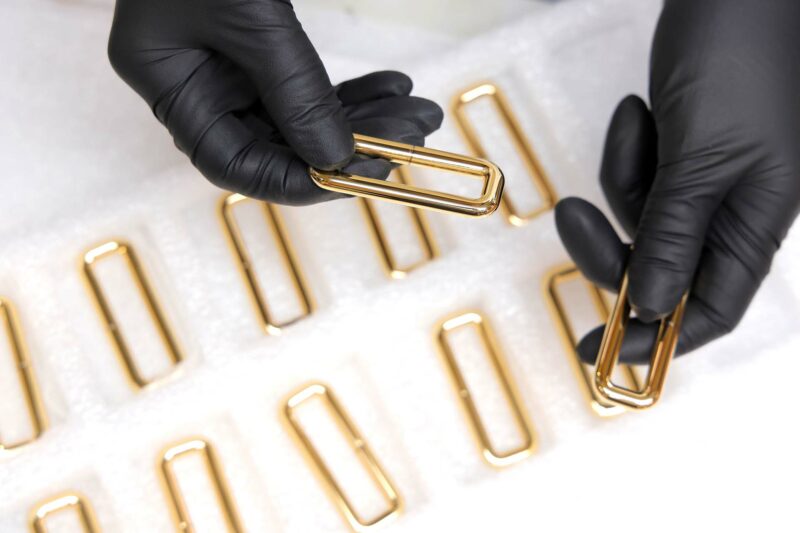
For decorative applications, typical thickness ranges between 0.25 and 0.5 µm. Even minimal variations can alter color, brightness, and hardness.
Costs, Complexity, and Potential
A PVD plant requires a significant initial investment: the vacuum chamber, pumps, and sources represent the most substantial part. Technical complexity is high and requires qualified personnel.
For these reasons, many companies make the strategic choice to outsource PVD processes to specialized partners like LEM, who can guarantee:
- High-end finishes
- Customized color palettes
- Superior wear resistance
- Industrial repeatability
Conclusion: Choosing the Right Partner
A PVD system is a complex technological ecosystem where every variable impacts the final result. It’s not just about the installed technology, but the expertise, control, and process management.
LEM acts as a reliable PVD partner for companies requiring consistent quality, high performance, and certified production standards. Our experience in plant management and rigorous parameter control transforms PVD into a real competitive advantage for our clients.
FAQ – Frequently Asked Questions about PVD Plants
What is the heart of a PVD system?
The vacuum chamber. It is the controlled environment where deposition occurs; vacuum stability and parameter precision determine the film’s quality and uniformity.
Why is part movement so important?
PVD is a “line-of-sight” process. Without rotation and planetary systems, “shadow zones” are created, compromising both thickness and color.
What are the main PVD technologies used in industrial plants?
The most common are sputtering, thermal evaporation, and cathodic arc. They differ in deposition method, speed, and the resulting film density.

Did you find the article interesting? Share it now.
Did you find something interesting? Contact us now!
LEM technicians are ready to address any questions or concerns you may have.
Request more information and discover our tailor-made solutions.